Sunday, 17 June 2012

Reconciled

In my previous post, I discussed how - at least according to the Biblical creation story - human beings have become estranged from their creator God. I argued that, whether or not this story is taken literally, its lessons remain valid.

Having discussed the problem I now want to introduce what I (and Christians everywhere) believe is the solution - specifically, the person, Jesus of Nazareth.

Many different religions have come up with different ways to address what is perceived to be the gulf between us and God, or us and perfection, or us and some kind of happiness/fulfilment, either now or in the life to come. There is much wisdom in many of these traditions, but Christianity - as far as I'm aware - is the only faith to claim that God has done something very specific from his side to solve this problem. According to the Christian faith, God isn't just sitting there waiting for us to work it all out - in fact he's very aware that although we may have caused this problem, it isn't one we are capable of solving all by ourselves.

So God - as Jesus - came and visited His creation. A ridiculous claim? Well, maybe, but one that I and many millions of other believers have become convinced is the truth. By coming here he showed and taught his followers and the rest of us how to live. And just by being who He was - challenging hypocrisy, standing up for justice, upsetting the status quo - he provoked his enemies into showing everyone how not to live as well! His presence brought out the best - and the worst - in human nature, as goodness always does when it refuses to back down. Driven by insecurity and jealous rage, his enemies crucified him as a common criminal, though He was innocent of any crime.

But what kind of God allows His enemies to do something like that? A weak God? An impotent God? Someone who isn't really any kind of God at all? Those enemies though, were not just a select group of angry people. In some ways they actually represented the whole human race. They reacted to Jesus the same way all of us often react to God. We are selfish, suspicious, protective of our own interests. We all like to be in control and react angrily at times when that control is threatened or taken away. All of us are capable of crucifying God in our hearts, and many of us do, every day!

So why not destroy us all? - something God is well able to do! But God wanted to do things a different way. His heart is full of love towards us, in spite of the hostility He often finds, and He wanted reconciliation, not war. So instead, He took the beatings and the mocking and the agonising death and the shame. He let humanity - let all of us - do their worst. Given a free reign, man had to kill God. It was the only logical outcome, right from our first rejection of Him when we ate from that tree (see previous post), but God wasn't going to leave it there!

Because of course you can't kill God - not in the end - and there was no way man was going to win. That wasn't the point though. God didn't want to "win" - and refused to fight on those terms. God just wanted to make it clear that in the end He couldn't lose. And one more much more important thing: God wanted to make it clear that He really does love us, no matter what we do! According to Luke's gospel, Jesus' actually prayed on the cross for His persecutors to be forgiven. Then after He died and rose from the dead - according to the Biblical accounts - He didn't come back with holy vengeance to wreak havoc on his enemies. Instead He slipped quietly away. And left His followers with a message of peace and reconciliation for anyone who would listen - that anyone who trusted in Him, could be forgiven for their sins and the relationship with God could be healed.

You might think it would've all fizzled out after that, but no. 2,000 years later, that message is still going strong and has completely changed the shape of this world. There are also many distorted forms of it around and it has been used and abused by those with vested interests, just as many of the powerful guardians of Jewish religion did in Jesus' day.

Its impact has not been lost though, and the central message of reconciliation is just as powerful now as it was then. Believe in Jesus - trust in Him, trust that He loves you, trust that He wants the best for you, be willing to learn to live life His way - and you too can be forgiven and reconciled with the creator God, the God who loves you and wants to be your father again!

Sunday, 10 June 2012

Estranged

I am not a Biblical literalist. Well I am, about certain things. I believe, for example, that the historical person, Jesus of Nazareth, was (and is) more than just a person. I believe that he was God come among us and that, after being crucified, he was physically raised from the dead. The early Christians - who lived during and shortly after his lifetime - lived and died for this belief, and I hope that - if it ever came to it - I would be prepared to do the same.

There are other parts of the Bible though, which go much further back, the origins and accuracy of which are much more difficult, if not impossible to trace or to verify. We still have many good reasons to value them and take them seriously though, and in my experience God speaks powerfully through them and they have a great deal still to teach us.

The earliest story in the Bible (that is, the one with the earliest setting), is of course the story of creation. This is not one of the stories I take literally, although I know this is controversial for some of my fellow evangelical Christians. It is a story though, that teaches us some very important things - about ourselves, God and the world around us.

One of the things this story tries to get to grips with is the problem of estrangement. Its author(s) plainly believed that God was real and that He was good - so why did He always seem so distant? And why was there so much evil in the world? The author(s) deal(s) with this by telling a story. In this story, God creates the world - which of course He must have done, somehow - and then makes people to live in it. These people are somehow more than just animals. They are in fact - in some small but very significant ways - like God Himself. God looks after these people - He gives them everything they need - and He trusts them. He gives them responsibility to rule over His world and - crucially - He also lets them choose whether they will be faithful to Him, or ignore Him and go their own way.

In the story, Adam and Eve - our actual, or metaphorical, ancestors - choose to go their own way. They give in to the temptation - presented to them by a serpent - of becoming even more like God than they already are. They eat from the tree of the "knowledge of good and evil" - which is the only thing God has told them they mustn't do. By doing this they are choosing to end their reliance on God's wisdom (and by extension His mercy) and rely on their own judgement instead. Shame and guilt quickly enter the equation as they realise that - without God's help - they are at the mercy of standards they can no longer live up to.

This decision excludes them from God's abundance and provision. They are thrown out of "the garden" - where all their needs have been met, and God has walked and talked with them - into the much harsher world outside, where they are left to their own devices (more or less) in accordance with the choice they have made.

However literally or otherwise we take this story, we can see the reality of it in our own lives and its effects on us and the world around us. Apart from the suffering and evil that are sadly so characteristic of life, God also seems extraordinarily distant, to the extent that many of us doubt, or have even altogether rejected, His existence. The signs of His presence are still all around us though - in the amazing beauty and complexity of nature, wherever and whenever we experience true love, joy or compassion, in our capacity for awe and wonder and in our searching and heartfelt questions about the nature and purpose of reality and of life.

The good news of course is that God hasn't entirely abandoned His creation. The rest of the first part of the Bible (the "Old Testament") is the story of His dealings with a particular group of people, as they struggle to understand Him and live in relationship with Him, and as He prepares a way to heal the rift between Himself and humanity and repair the damage that has been done.

The healing of this rift was the primary purpose of the life, death and resurrection of Jesus of Nazareth - the subject of my first paragraph. How exactly this helps, is the subject of my next post …

Tuesday, 1 May 2012

A World Without Money

I recently came across this video on the BBC news website about American, Daniel Suelo, who has chosen to live entirely without money for the last 12 years. Although I have to admit that for most people it doesn't sound like a very practical option, I did nevertheless find his story very inspiring.

Suelo survives by foraging and scavenging and on gifts from friends and strangers. His philosophy is to use only what is freely given or discarded, or already present and available.

Suelo has proved that it is possible for one person to live like this, but what if everyone tried? If we all tried to live out of dumpsters or on hand-outs, who would do the work of producing the food and other resources that we all need? Is Suelo a visionary demonstrating a new way to live, or just a bum who lives off other people's hard work? Suelo's own answer to that question is here, but here are some of my thoughts:

First off - as I suspect many of my readers will have already concluded - it doesn't seem realistic to me that everyone should try to live like Suelo. There are 7 billion of us on this planet and we can't all survive by scavenging. There wouldn't be enough food (or caves - such as the one Suelo lives in!) to go around. I do think though, that Suelo's choice of lifestyle nevertheless presents a very real challenge to the rest of us which does deserve to be taken very seriously.

On his website, Suelo goes so far as to compare our financial system of credit and debt with the tree of the knowledge of good and evil. For those not familiar with the Bible, this is the tree from which Adam and Eve - the first humans - ate, when they rebelled against God in the garden of Eden. If Suelo's comparison seems a bit of a leap, consider that before their rebellion, Adam and Eve lived in a permanent state of grace. There were no rules and they had everything provided for them - all they had to do was gratefully receive it and obey God by not eating from that tree! But rather than trust God, they ate from the tree - thus choosing self-sufficiency instead. Cut off from God and His loving influence by their own choice, humanity quickly deteriorated into all kinds of wickedness. This was compounded by the guilt they now had from their new-found insight into the nature of right and wrong. Cut off from God's grace and forgiveness, they designed systems to try to control their destructive behaviour ... and to keep score!

Meanwhile, money - credit and debt - is another way of keeping score and of trying to be in control. It's all about entitlement. If I have this piece of paper, then I'm entitled to that product or those services. We all know where we stand as long as everyone keeps the rules. In the beginning though, there was no entitlement, no keeping score. In a world where love and grace are in charge, there is simply no need for these things.

Having thought this through a little further, I find myself coming to the somewhat startling conclusion that at it's core - as necessary as it may seem to modern life - money is in fact profoundly anti-Christian! The Bible never goes so far as to condemn all money outright, but it does radically undermine that sense of entitlement on which all financial transactions depend. If Suelo's way of life seems radical, listen to some of Jesus' words on this subject:
Therefore I tell you, do not worry about your life, what you will eat or drink; or about your body, what you will wear. Is not life more than food, and the body more than clothes? Look at the birds of the air; they do not sow or reap or store away in barns, and yet your heavenly Father feeds them. Are you not much more valuable than they? Can any one of you by worrying add a single hour to your life? 
And why do you worry about clothes? See how the flowers of the field grow. They do not labour or spin. Yet I tell you that not even Solomon in all his splendour was dressed like one of these. If that is how God clothes the grass of the field, which is here today and tomorrow is thrown into the fire, will he not much more clothe you – you of little faith? So do not worry, saying, “What shall we eat?” or “What shall we drink?” or “What shall we wear?” For the pagans run after all these things, and your heavenly Father knows that you need them. But seek first his kingdom and his righteousness, and all these things will be given to you as well. Therefore do not worry about tomorrow, for tomorrow will worry about itself. Each day has enough trouble of its own.
Do not store up for yourselves treasures on earth, where moths and vermin destroy, and where thieves break in and steal. But store up for yourselves treasures in heaven, where moths and vermin do not destroy, and where thieves do not break in and steal. For where your treasure is, there your heart will be also.
No one can serve two masters. Either you will hate the one and love the other, or you will be devoted to the one and despise the other. You cannot serve both God and Money.
If you want to be perfect, go, sell your possessions and give to the poor, and you will have treasure in heaven. Then come, follow me.
Consider these words as well, written by the apostle Paul - one of the earliest of the first generation of Christian leaders:
Godliness with contentment is great gain. For we brought nothing into the world, and we can take nothing out of it. But if we have food and clothing, we will be content with that. Those who want to get rich fall into temptation and a trap and into many foolish and harmful desires that plunge people into ruin and destruction. For the love of money is a root of all kinds of evil. Some people, eager for money, have wandered from the faith and pierced themselves with many griefs.
Finally, consider the explosive effect that the original Christian message had on some of its earliest converts:
All the believers were together and had everything in common. They sold property and possessions to give to anyone who had need.
All the believers were one in heart and mind. No one claimed that any of their possessions was their own, but they shared everything they had. With great power the apostles continued to testify to the resurrection of the Lord Jesus. And God’s grace was so powerfully at work in them all that there was no needy person among them. For from time to time those who owned land or houses sold them, brought the money from the sales and put it at the apostles’ feet, and it was distributed to anyone who had need.
One of the most immediate and powerful effects then, of the "gospel" - the message of God's grace made available to us again through Jesus, as it was originally understood - is that the barriers of "entitlement" are broken down. "No one claimed that any of their possessions was their own". It doesn't matter any more! That's grace in action!

Most Christians alive in the world today - sadly including myself - have lost the initial power and impact of this message, but whether we like it or not, this is still where we are all going!

There has been much speculation in Christian circles for 2,000 years regarding the nature of the afterlife. The idea of some sort of ethereal heavenly bliss that has been promoted so heavily by the church for centuries is now slowly giving way again in many quarters to the idea of bodily resurrection to a new/renewed creation, as was originally preached by the early believers. Whatever the next world is like though - whether it's completely disjointed from this one or is in some way a continuation of it - there are certain things we can be sure about if we take seriously anything the Bible has to say:
  1. God will be very present there, and God will be in charge.
  2. It will be a world ruled by love - because God is love - and by grace.
  3. It will be a world free from evil. Evil will have had it's day in this world and having done its worst, will be given no place in the new one.
Will there be any "entitlement" in the new world? Will there be rules and regulations? Will there be credit and debt? Will there be money?

I suspect not!

Wednesday, 4 April 2012

The Hunger Games

The weekend before last (OK, so I'm getting a bit behind with my posts!) I went to see The Hunger Games.

For those who haven't seen it and are not familiar with the plot, the film is set in a post-apocalyptic future in a nation called PanEm, in the geographical area that was once North America. PanEm consists of 12 impoverished districts, which are ruled by a totalitarian government based in the wealthy and technologically advanced Capitol. As punishment for a previous rebellion, each year the districts must send 2 children each, from between the ages of 12-18 to compete in a televised fight to the death called, "The Hunger Games", from which only one contestant is allowed to emerge alive.

The film follows a girl called Katniss in particular, and also a guy called Peeta, as they are selected, trained for, and then compete in the games. None of the competitors want to be there, but they must learn to survive, and be willing and able to kill their fellow competitors if they want to make it back home alive to their families and friends.

During the preparation period, before they enter the arena, Peeta confides to Katniss, "I don't want them to change me in there. Turn me into some kind of monster that I'm not." This is the main dilemma faced by Peeta and Katniss (and many of the other contestants). They have been placed in a situation which has completely different rules from the ones that - in their hearts - they know they should be following, and indeed want to follow, and yet if they don't follow the rules of the game they are almost certain to lose everything. How will they respond?

I won't spoil the film for you if you haven't already seen it - and if you have, then you won't need my explanation - but it struck me that to some extent this is a dilemma shared by all of us. We live in a world that seems to be governed by many Rules that in our heart of hearts we would perhaps rather not have to follow. I'm not referring so much now though to rules made by governments, I'm thinking instead about the Rules that seem to emerge by themselves and which we come to accept as simply, "the way things are". Rules like, "it's a dog eat dog world", or, "you have to look out for number one", or even perhaps, "charity begins at home". It would be nice we might think, to look out for other people, to put their needs first and give to anyone who has need, but the world just doesn't work like that. We have to put our own needs first or we will lose out, and sometimes even our survival must take precedence over everything else.

Just over 2,000 years ago, another player entered the "arena" that is our world and chose to do things very differently. He challenged injustice, spent himself on behalf of others and didn't respond with violence even when others tried to kill him. The result? - he was tortured and then executed - just as you might expect, in accordance with the Rules in the previous paragraph. If that had been the end of the story, it would have simply confirmed our suspicion that no-one can get away with breaking the Rules for very long! Fortunately for us though, this wasn't the end, because for some reason, when this particular player chose not to play by the Rules, something very special happened ... he broke The Game!

The Bible teaches us that the world was never meant to work according to these Rules, rather, these are the Rules that came into play when people decided they wanted to run the world their way and could do so without any help from God. When God himself (in the person of Jesus) entered The Game and disobeyed its Rules, The Game broke, because it didn't have any power over the one who had created the world in the first place. It cost God dearly to do that - he paid the price demanded by The Game - but The Game couldn't keep him down. On the third day, he rose again bodily from the grave, appeared to his disciples, and returned to Heaven from whence he came. After this, he clothed his followers in Rule-breaking power and they went on to sacrifice themselves tirelessly and unselfishly to spread the message of his triumph, releasing everyone who believed their message to live their lives free from the Rules of The Game.

Friday, 23 March 2012

Does Prayer Work?

Yes. No. Maybe. It certainly doesn't "work" in any kind of scientifically testable or verifiable sense, but that's because prayer is a relationship and relationships don't tend to work like that.

I've prayed plenty of prayers that haven't been answered in any kind of way that I would recognise, but I've also prayed some that have. Some would say that if you pray enough prayers then - statistically speaking - one of them is bound to get answered eventually. The following is a true story of something that happened to me last weekend. Perhaps it was just a co-incidence or a statistic. What do you think?

Last Saturday I lost my wedding ring. I knew I'd taken it off some time in the morning to do some DIY and I discovered it was missing at about 6pm. I hunted all over the house for it. I thought I'd probably put it in the coins pocket at the front of my jeans, but it wasn't there so I hunted everywhere else I could think of. I also knew the coins pocket wasn't entirely safe... I keep my keys there as well and had noticed previously that when I take the keys out, the ring can occasionally catch on the keys and go flying across the room. I should have stopped putting my ring in that pocket after that... But I hadn't...

I knew I'd taken the keys out three times that day - once to lock the gate that bars my back door so I could leave the door open as I was busy around the house, once more to open the gate again when I decided to close the door a few minutes later because it was colder outside than I had thought, and once when I changed my trousers at the end of the day. I hunted all over the bedroom in case the ring had flown out somewhere. I hunted around the kitchen, near the back door, and even outside in case the ring had flown out the door and into the yard.

My wife also hunted everywhere - she's often better at finding things than I am - but without success. So having looked everywhere either of us could think of, we prayed! I said sorry to God for my negligence in not taking care of the ring more carefully, acknowledged that He knew where it was, and asked Him if He could please show it to us.

Having prayed, we had our evening meal and went out to a friend's house for the evening. On the way back I thought about the ring again, but instead of worrying about it I considered once more that God knew where it was and somehow I felt confident that He would show it to us. As I thought this I felt a brief but re-assuring sense of His presence come very close to me.

As we walked along the back street towards our house - before we even got to the house - Emma happened to look down as something on the ground caught the light from a street light. She bent down, picked it up, looked to see what it was, and was a little shocked to discover that there in her hand was my wedding ring!

Sunday, 18 March 2012

Beauty is where you find it

Everything below is an extract from Mark Powley's Consumer Detox blog. I think it speaks for itself and I liked it so much I've simply reposted it. You can find the full (and much longer) Washington Post report here.

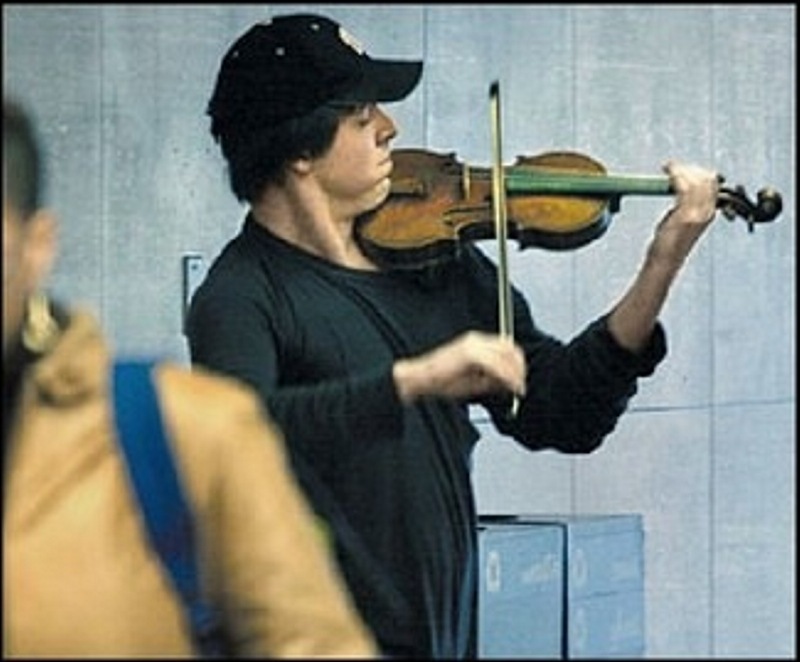
In Washington, DC, at a Metro Station, on a cold January morning in 2007, this man with a violin played six Bach pieces for about 45 minutes. During that time, approximately 2,000 people went through the station, most of them on their way to work. After about 3 minutes, a middle-aged man noticed that there was a musician playing. He slowed his pace and stopped for a few seconds, and then he hurried on to meet his schedule.

About 4 minutes later: The violinist received his first dollar. A woman threw money in the hat and, without stopping, continued to walk.

At 6 minutes: A young man leaned against the wall to listen to him, then looked at his watch and started to walk again.

At 10 minutes: A 3-year old boy stopped, but his mother tugged him along hurriedly. The kid stopped to look at the violinist again, but the mother pushed hard and the child continued to walk, turning his head the whole time. This action was repeated by several other children, but every parent – without exception – forced their children to move on quickly.

After 45 minutes: The musician played continuously. Only 6 people stopped and listened for a short while. About 20 gave money but continued to walk at their normal pace. The man collected a total of $32.

After 1 hour: He finished playing and silence took over. No one noticed and no one applauded. There was no recognition at all.

No one knew this, but the violinist was Joshua Bell, one of the greatest musicians in the world. He played one of the most intricate pieces ever written, with a violin worth $3.5 million dollars. Two days before, Joshua Bell sold-out a theater in Boston where the seats averaged $100 each to sit and listen to him play the same music.

This is a true story. Joshua Bell, playing incognito in the D.C. Metro Station, was organized by the Washington Post as part of a social experiment about perception, taste and people’s priorities.

This experiment raised several questions:
  • In a common-place environment, at an inappropriate hour, do we perceive beauty?
  • If so, do we stop to appreciate it?
  • Do we recognize talent in an unexpected context?
  • If we do not have a moment to stop and listen to one of the best musicians in the world, playing some of the finest music ever written, with one of the most beautiful instruments ever made, how many other things are we missing as we rush through life?

Sunday, 26 February 2012

Gawd Bless 'er Majesty!

I've just recently finished watching - and have been quite impressed by - Andrew Marr's Diamond Queen series on BBC1.

I have mixed feelings about the monarchy and used to feel quite opposed to it.

There's that whole thing about a privileged few people, who just happen to have been born into a certain family, living in the lap of luxury at the tax payers' expense. It's also not very democratic - these people who we've never elected, still somehow represent us and our interests, at home and on the international stage.

Then there's the whole church thing. I've never felt very happy with the idea of any one person being declared "head" of a church, when the only "head" that the church ever had in scripture was Jesus himself. Even more strange though, is the idea of someone being head of a church, just because they happen to be the ruling monarch. Surely such a role - if it should even exist - should be assigned on the basis of a person's spiritual credibility, not on the basis of what family they happen to have been born into? What if the monarch is not even a believing Christian? How could they possibly, in any meaningful sense, be the head of a church whose beliefs they don't even agree with?

All those comments aside however, I do have a great deal of respect for Queen Elizabeth II. Andrew Marr is obviously very pro-royal and I have no doubt been swayed to some extent by his - not entirely unbiased - presentation, but it did also resonate with much of what I have previously observed. Her majesty is obviously by no means perfect, but I do believe the British Nation has an awful lot in her to be grateful for.

The Queen - and many of the other royals - seem to attend an endless stream of public engagements. I've never really understood the fuss of seeing a member of the royal family drive down a road in a carriage or stop to give someone a wave - they're all just people after all, but I can see that to many people it does make a difference. The Queen has little if any real power, but the job isn't about power any longer, it's about relationship. To some extent, when the Queen visits somewhere, she embodies Britain. If she visits somewhere within Britain then she carries the message that Britain cares about that place, and for a moment at least, the eyes of Britain are focused there. If she is received warmly in another country then Britain is received warmly, animosity is diminished and ties of friendship between nations are developed.

The monarchy also gives us the benefit of longevity. Our politicians are elected for 4-5 years at a time and may perhaps manage 3 terms at the most. For voters this is a benefit because it means that if we don't like our leaders we can change them fairly quickly. For politicians though, as well as keeping them on their toes and reminding them of who they are accountable to, it also often pressures them into taking a short term view. More than anything else, elected leaders want to be re-elected, which means they have to do the things that will make them popular in 4-5 years time. These may not necessarily be the things that are best for the country in the long term.

Our Queen however, has been on the throne for nearly 60 years! - and in that time has seen 12 different Prime Ministers. She religiously and regularly reads through reams of government documents and along with the Prime Minister and the Chief Secretary to the Treasury, is said to be one of only 3 people in the country who really understand what's going on! She meets with the Prime Minister - of whatever political party - every week, and has a full and candid discussion on government issues, gives the benefit of her advice and offers her opinions. She has no power to make decisions but to my mind this is still an invaluable role. Who else does a Prime Minister have to turn to for outside help who has such a depth of wisdom, knowledge and experience?

The thing that impresses me most about our Queen though, is that I am convinced that she sees herself - and has always seen herself - as a genuine public servant. She may live in the lap of luxury, and I am sure that has many benefits, but as far as I can see she devotes herself tirelessly - and has always devoted herself - to the service of her people. She doesn't just do the job, she lives it and can never walk away (unless of course she abdicates, like her uncle previously did!).

In times gone by, the monarchy was an instrument of power, and often a very oppressive power at that. In the 20th and 21st centuries however, it's role has become much more symbolic. To me, some of the symbols of monarchy and which monarchy represents, still seem to reek of the oppression of the past, but in Elizabeth herself at least, I see a monarch who is genuinely there to serve rather than to be served. Her 21st birthday speech in 1947 in Cape Town, South Africa, included these words, addressed to the Commonwealth: "I declare before you all that my whole life, whether it be long or short, shall be devoted to your service  ... God help me to make good my vow, and God bless all of you who are willing to share in it." 65 years later, I think we can safely say, that she has lived up to those words!