Saturday, 23 October 2010

Rev

(Warning - this article includes plot-spoilers for an episode of Rev)

A couple of days ago I watched a recorded episode of Rev in which the Vicar has a crisis of faith. This is brought on initially by a review of one of his sermons on the internet, which gives him a mark of -1 out of 10! (this plot line seems to be derived from The Ship of Fools - Mystery Worshipper). The Vicar's disappointment quickly blooms into wondering: does God really care about him?; if God really exists why does he allow so many bad things to happen to people?; etc.; etc.; etc. Consequently, the Vicar goes completely off the rails for a bit, tries (unsuccessfully) to have an affair, gets drunk at a party, tells his wife to f*** off, and tries to pick a fight with a bunch of local hooligans from which he is fortunately rescued in the nick of time by the police!

The Vicar never finds any concrete answers to his deep and existential questions, but what seems to bring him back into line in the end is a realisation that people are depending on him - that he has a job to do and if he doesn't do it then no-one else is going to. This made me wonder about the role of a vicar and the expectations that people put on them. I'm not from a Church of England background so my experience of church leadership is a little different, although there are still many similarities.

One of the themes that comes over quite strongly in the series, is that people expect the Vicar to be spiritual/godly/righteous because it's a vicar's job to be like that. A vicar is expected to be more holy than "normal" people and "normal" people therefore, don't have to be that holy because they're not vicars. This seems to me to be a long way from the Christianity of the Bible. Yes, leaders are supposed to set an example - as the apostle Paul said, "Follow my example, as I follow the example of Christ" (1 Corinthians 11:1) - but it's an example to be followed, not just appreciated from afar!

I think there are a lot of things, particularly about the way the Church of England (and many of the other more formalised Christian denominations) is set up, that accentuate this sort of attitude - for example the dog collar, the special clothes, the fact that only vicars are allowed to perform certain rituals. All of these seem to me to accentuate the idea that vicars are special - more spiritual somehow than the rest of us. I think this works for vicars because it tends to make them feel - if not more important than other people - then at least more significant somehow in their particular role. I think it also tends to work for parishioners because it means they can pretty much get on with life as normal, knowing there is someone else there whose job it is to be spiritual on their behalf!

At the end of the episode, Adam (the Vicar) is jolted back to reality by one of his parishioners who is seriously ill and close to death, and has been hanging on for her vicar to give her the last rites. It is at this point that Adam remembers his calling and for him it is the turning point that brings him back onto the straight and narrow. For me though, I couldn't help wondering about the strange relationship between this woman and her vicar. Adam has a tiny congregation and the implication is that this woman is not part of it and doesn't know Adam, since Adam had no idea she was ill. But she still seems to see the Vicar as some sort of gateway - an interface if you like - between the earthly world of her daily existence and the spiritual life, which has suddenly become a lot more important to her as she feels herself rushing towards it! Adam's job of course - if he is a good vicar - is to point the woman away from himself and back towards Jesus, who is the only one who can truly take responsibility for her soul. But if all the woman's expectation is focused on the Vicar this may not be an easy thing to do - she is likely to accept the words that he uses but for her the meaning may be very different - so that from her point of view Adam may end up with a role that no normal man or vicar should ever have to try to perform!

Sunday, 3 October 2010

Russell Brand on Celebrity

I've never been a fan of Russell Brand.  Until Friday I probably would have described him as a crude, insensitive, exhibitionist egomaniac.  Many people would of course add "extremely funny" to that list, but I'm afraid I've struggled to see past those first four things!

While I can't say that my impression has changed completely, I was reminded on Friday that human beings are multi-layered and complex and that there's nearly always a lot more to people than first meets the eye.

On Friday, Russell gave an interview to Jeremy Paxman on Newsnight, on the subject of "the cult of celebrity".  The full interview is still available on the BBC website here.  To me, Brand has been one of the people who has seemed to embody the shallowness of that cult, and yet I've rarely if ever heard a celebrity talk so much sense about it (or in so animated a fashion!).

Here are a few snippets from the interview:

...
Brand: We're presented with the attractive spectacle of fame to distract us from the mundanity of our every day lives.

Paxman: It's utterly empty.
Brand: Of course.

Paxman: In itself it is not something worth striving for.
Brand: It has absolutely no value of itself.  It's a spectacle, an illusion, a distraction.  I think all of us are aware of that on some level.

Paxman: I sometimes think it might be something to do with religion - and the decline of religion.
...
Paxman: It's about significance.  Famous people appear to have significance and previously it was religion that gave people that sense they had a significance.

Brand: ... No-one cares about religion anymore ... because we've been fed this grey sludge of celebrity glittered up and packaged and lacquered and sent directly into our brains by the media that both you and I work for in different degrees.

Paxman: What happens to you when [fame] arrives?
Brand: What happens is you have the initial thrill of achievement - [you think] "Oh my word!" - the same as if you'd acquired a pair of shoes that you'd long craved and then you realise that the shoes are too tight, they ain't comfortable, "I want another pair of shoes!", "Walking around in these things ain't the same as I thought it would be!", and you realise that you need nutrition from a higher source, something more valuable.  Celebrity in and of itself is utterly utterly vacuous.  It's like being presented with the most glorious meal and then when you eat it there's no taste, there's no succour, there's no nutrition.  It's tiresome.
...
Brand: Now that I'm here I wonder if it's possible to use it to acquire something more valuable, more beautiful and to illuminate those ideas.
...
Brand: Someone told me once that all desire is the desire to be at one with God in substitute form.  So perhaps we can draw attention not to the shadow on the wall but to the source of light itself.

Paxman: Do you believe in God?
Brand: Yes.
...
Paxman: Do you worship?  Do you go to church?  What do you do?
Brand: I pray and I meditate and I try to align my desires with things that are less selfish and it's an ongoing struggle because of the egotism and the needs in me and stuff.  I'm just trying to be a better person.

Paxman: What do you think we should aim for then?
Brand: I think that we should try to examine the things that we're using to make us happy - this pursuit of celebrity, of wealth, of status, this consuming of products, this ignorance towards ecological and economical matters and try and aspire to something more beautiful - something more truthful and honest.
...
Brand: Perhaps if we were all in tune with more beautiful things, perhaps we wouldn't prioritise such peculiar ideas and notions.
...

Comments anyone?

Saturday, 18 September 2010

A Modern Creation Myth

No-one knows for sure exactly how the world started, since none of us were there to see it.

The Biblical creation account in Genesis is, in my view, a God-inspired myth.  It's a story, set within the cosmos according to the way the Jews understood it at the time, which attempts to encapsulate what they knew about God, the world He created, and our place within that world.

Nowadays, modern science has uncovered a lot more about the way the world works and has advanced various theories regarding it's history.  None of these theories are complete and what we think we know is constantly being challenged and refined.

Here is a modern "creation myth" based on the generally accepted current understanding.  (I prefer to think of it as supplementing, rather than replacing the original).  I found it in Arthur Peacocke's "Paths from Science Towards God":

There was God. And God was All-That-Was. God's Love over-flowed and God said, 'Let Other be. And let it have the capacity to become what it might be, making it make itself - and let it explore its potentialities.'

And there was Other in God, a field of energy, vibrating energy - but no matter, space, time or form. Obeying its given laws and with one intensely hot surge of energy - a hot big bang - this Other exploded as the Universe from a point twelve or so billion years go in our time, thereby making space.

Vibrating fundamental particles appeared, expanded and expanded, and cooled into clouds of gas, bathed in radiant light. Still the universe went on expanding and condensing into swirling whirlpools of matter and light - a billion galaxies.


Five billion years ago, one star in one galaxy - our Sun - became surrounded by matter as planets.  One of them was our Earth.  On Earth, the assembly of atoms and the temperature became just right to allow water and solid rock to form.  Continents and mountains grew and in some deep wet crevice, or pool, or deep in the sea, just over three billion years ago, some molecules became large and complex enough to make copies of themselves and became the first specks of life.

Life multiplied in the seas, diversifying and becoming more and more complex.  Five hundred million years ago, creatures with solid skeletons - the vertebrates - appeared.  Algae in the sea and green plants on land changed the atmosphere by making oxygen.  Then three hundred million years ago, certain fish learned to crawl from the sea and live on the edge of land, breathing that oxygen from the air.

Now life burst into many forms - reptiles, mammals (and dinosaurs) on land - reptiles and birds in the air.  Over millions of years the mammals developed complex brains that enabled them to learn.  Among these were creatures who lived in trees.  From these our first ancestors derived and then, only forty thousand years ago, the first men and women appeared.  They began to know about themselves and what they were doing - they were not only conscious but self-conscious.  The first word, the first laugh were heard.  The first paintings were made.  The first sense of a destiny beyond - with the first signs of hope, for these people buried their dead with ritual. The first prayers were made to the One who made All-That-Is and All-That-Is-Becoming - the first experiences of goodness, beauty and truth - but also of their opposites, for human beings were free.

Thursday, 19 August 2010

Hidden Where Everyone Can See

I finished my last post with a quote from Jesus about how, paradoxically, God often hides truth from the "wise and learned" (or at least, from those who think they are). I also commented that I don't think any amount of scientific investigation will ever prove irrefutably that God exists. That's not to say though, that I don't think there's any evidence!

It's often been said that the best place to hide something is in plain sight, because people often have a tendency to miss things that are right under their noses. It seems to me that the evidence for God's existence is everywhere - it's completely obvious whilst also being quite easy to ignore. The apostle Paul takes a similar line in the New Testament book of Romans:

"For since the creation of the world God's invisible qualities—his eternal power and divine nature—have been clearly seen, being understood from what has been made, so that men are without excuse." - Romans 1 verse 20

No-one really knows - ultimately - how the universe came to be. For every scientific answer we can give there will always be another question, e.g. "why did that happen?", "what was before that?", etc. God as the final answer doesn't really solve this problem because it just raises similar questions, e.g. "where did God come from?", "how did He come into being", etc. Perhaps the main difference with the God answer though, as the final answer that ultimately underlies all other good and true answers, is that it includes the conviction that this question will never be answered. God is the final answer by definition - He is, among other things, that which always was and ever will be.

The universe and our world appear to be full of "co-incidences", without which life as we know it, and probably life of any kind, would not be sustainable (see http://en.wikipedia.org/wiki/Fine-tuned_Universe and http://en.wikipedia.org/wiki/Rare_Earth_hypothesis). To me these are markers of God's providence, but for sceptics there will always be other possible explanations.

Apart from being full of "co-incidences", the universe is also full of awe - wonder and beauty. There is so much out there to delight and astound us. Why is it all so wonderful? Why does it affect us in this way? Why is there even an "us" to be so affected? Some people think these reactions can (at least potentially) be explained by evolution, which in turn is governed entirely by the need to survive. To me though, this is evidence of the spiritual side of life and the existence of something higher of which we are a part.

The Biblical creation story (which I take as metaphor, rather than as literal scientific truth), says we were made in God's image and put here as stewards - to look after His world. If instead we did get here purely by evolution, then in my view evolution still has a lot of explaining to do. Somehow we appear to have broken the mould - the system has produced something which has broken out of the system and now has the formidable power to destroy it!

And finally, there is love. From a purely logical and personal point of view it doesn't make any sense. Why should I put someone else's welfare before my own? Why should I value another person, unless I personally benefit from this transaction? And yet we all need to be loved - for who we are and not just for what we can contribute - and we all know that if we could all love each other, the world would be a far far better place!

The Bible teaches that God is love. Love comes from God and we are all loved by Him. God showed His love to the ultimate, by sacrificing Himself / giving up His Son (it reads both ways) - demonstrating that He really meant business. This is a God we can trust - not one we need to rebel against. A God who really does have our best interests at heart and will go to any lengths necessary on our behalf. The way of love though, is the way of sacrifice, and not the way of power that we all crave. It means laying down all our petty power and control strategies and learning to trust. I'll let you know when I get the hang of it… :-)

Wednesday, 4 August 2010

A Different Kind of Knowledge

I've been thinking a lot recently about spiritual vs. non-spiritual world-views.

Most atheists - in my experience - are also scientific materialists. This means they believe only in the material world, where "material" means that which is potentially accessible to scientific investigation. If anything non-material exists then either it never interacts with the material world, in which case it is irrelevant, or if it does then we must be able to detect it and thus potentially scientifically analyse it in some way, in which case it is in fact a "material" thing, albeit a different kind of material from anything else we've encountered.

Most non-atheists on the other hand, believe there are (or at least may be) things in life, including for example God, spirituality etc., which may not be open to scientific proof or investigation, but which may be no less real and may significantly impact our lives.

While I have some sympathy with the first position, I nevertheless find myself quite squarely in the second camp. Rather than try too hard to justify this though, I thought I would just tell you my story:

I grew up in an evangelical Christian home and was taught from an early age that God was real and He loved me and that Jesus was God's Son, who died and rose again so that I could be forgiven for my sins.

When I got to the age of about 13 I started to question all this. Deep inside I felt instinctively that it was true, but I was also aware that I was in a minority and that most of the people around me didn't believe this stuff. I wondered whether actually, I only believed it because I'd been taught to, at home and at church, and because I happened to have grown up surrounded by a lot of other Christians who believed it as well.

I didn't have an easy adolescence, for various reasons and at this point was feeling pretty depressed about life. I came to the conclusion that if there was no God and no afterlife then it was basically pointless - you lived, you died. I wasn't enjoying life and I figured death was an easy escape - no more suffering, no more mental or emotional anguish. I knew I'd miss out on a lot of good stuff, but so what - I'd be dead so it wouldn't matter would it?  On the other hand, if there really was a God then perhaps there was something worth living for? - I needed to find out!

I remember going to a prayer meeting where we were all encouraged to pray for a "God encounter". This sounded like something I needed so I joined in fervently. I didn't know what I expected to happen and wasn't really surprised or disappointed when nothing did. Afterwards I walked home on my own, which must've taken about 20 minutes. Half way home, out of nowhere, God descended on me - that's about the only way I can describe it! I had an overwhelming sense of His presence and love which was like nothing I'd ever felt before. I also had an acute sense of my own sinfulness. I suddenly and unexpectedly became aware of all my self-centredness and unpleasant attitudes. As I responded to God's love and forgiveness though, I felt as though I was being cleaned up - like all the bad stuff was being washed out and replaced by God's love and acceptance.

This was the first I can remember of many experiences of God I've had over the years - some subjective and personal, some more external, some quite obviously miraculous and many more subtle and open to interpretation. My purpose is not to list them all here though, or to convince you to believe in God on the basis of my experience.

Later on, at university, I did a science degree. I very much liked (and still do) the scientific way of thinking about things. I recognise that human beings are deeply subjective and that subjectivity often leads to false and sometimes harmful conclusions. I am deeply attracted to the idea of an objective method which can cut through all this confusion and replace it with hard facts.

I have experienced too much and know too much however, to accept that this is all there is to life - and many of my experiences are not open to scientific investigation (although some of them may be open to alternative interpretations). I believe in an all powerful God, who could show Himself in an instant and prove to everyone that He was real if He wanted to. However, since His existence isn't totally and irrefutably obvious, I can only conclude that He doesn't want it to be - in which case no amount of scientific investigation will ever prove irrefutably that He exists.

I know that people believe subjectively in all sorts of things which are patently false. I probably have many false beliefs of my own which I nevertheless defend vigorously! This sometimes makes me feel insecure about reality and truth. I'd like a universe which is always predictable and which - potentially at least - I can explain. I'd like there to be some objective standard - and this is how many see the scientific method - against which all truth claims can be measured and all disputes settled.

In my experience though, God-knowledge is not like this. God-knowledge starts in the heart and not in the head. God makes His truth accessible to those with the right attitude, not to those with the best brain. It is primarily dependent on His revelation, not our investigation. As Jesus once said, "I praise you, Father, Lord of heaven and earth, because you have hidden these things from the wise and learned, and revealed them to little children. Yes, Father, for this was your good pleasure."

Monday, 2 August 2010

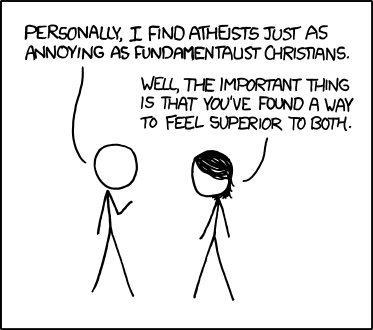
A Superior Perspective!

I really liked this cartoon from today's xkcd:


Good job I'm not like this!  Oh, wait...  :-)

Saturday, 24 July 2010

When is the Church not the Church?

I'm a bit late in the day on this, but someone at work alerted me to this recently and I was a little horrified so I decided to do some digging.

After an 18 year legal battle, a couple have been forced to sell their farm house in order to pay more than £200,000 in repairs to their local parish church because of an archaic medieval law making some land-owners liable for repairs to nearby churches. The Wallbanks have also racked up £250,000 in legal costs contesting this decision which was initially overturned by the Appeal Court as a breach of the couple's human rights. However the PCC (Parish Church Council) then took the case to the House of Lords, who overturned the appeal on the basis that the Human Rights Act did not apply because PCCs are not Public Bodies. 

This is what the Church of England had to say about the case (see here): 

"The Church of England has financial responsibility for 45% of the nation’s Grade 1 listed buildings and many other architecturally important churches. 70% of repair bills are met by local fundraising, with only a minority coming from English Heritage, lottery funds and other non-church sources. This places a considerable financial burden on PCCs, which largely rely on voluntary giving to support their work. Against that background, the Church cannot be expected to forego sources of funding to which it is entitled unless it receives adequate compensation." 

This makes me really angry! 

In the Bible, in the New Testament, the apostle Paul refers to the church as "the body of Christ". The analogy is, that when Jesus lived on earth he went around showing people, by His words and actions, what God was like. He loved people, He taught them, He did miracles and He showed compassion. He also had some angry words to say against systemic corruption and abuse of power! Now that Jesus is no longer physically here on earth, His church - those who follow Him and are filled with His Spirit - have become His "body". We're supposed to go around doing the things that He did and still wants to do through us, His disciples. 

When the church puts financial gain - even financial need - first, and uses this to justify forcing a couple to sell their home for a liability that in real day to day terms (as opposed to obscure legal terms) has little or nothing to do with them, it forfeits the right to be called "the body of Christ" - since Christ would never have dreamed of treating anyone in such a way!

To find out more about the Wallbanks' case from their own perspective, see here, although the site has not been updated since before the couple sold their farm and the petition is now closed, so it looks as though they have sadly had to give up their fight.